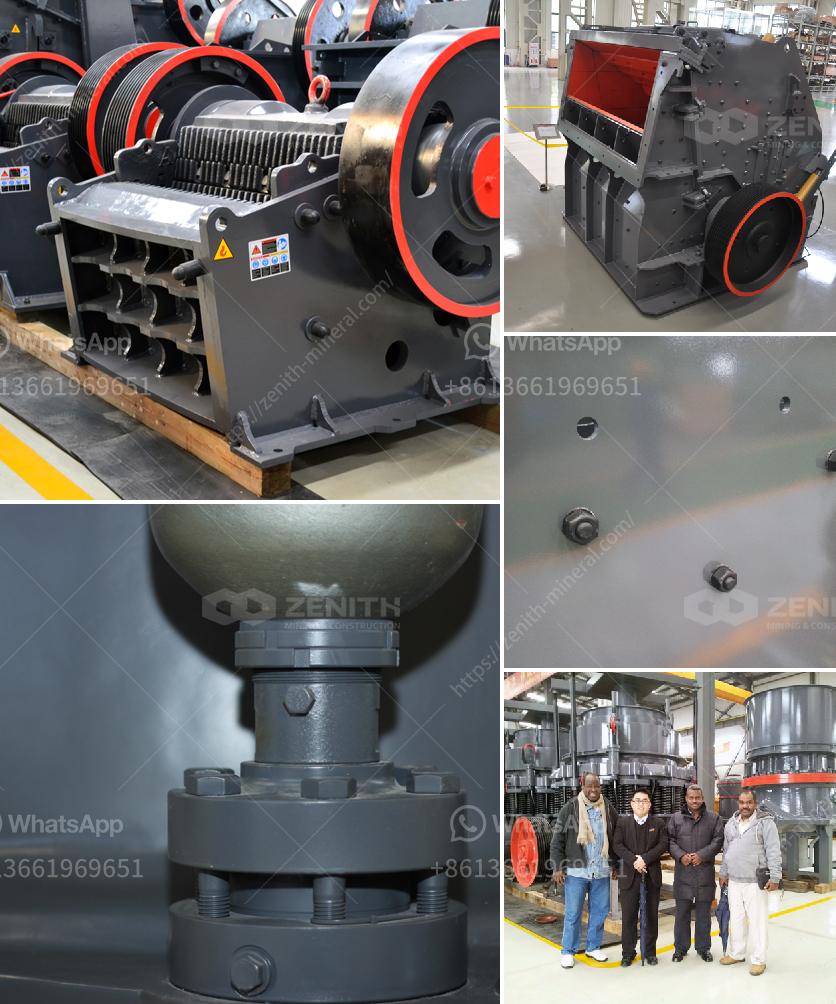


Calculating the production capacity of a cone crusher involves several factors and requires a detailed understanding of the machine's specifications and the material being processed. Here’s a comprehensive guide to help you understand the process:
First, you need to gather all the relevant specifications of the cone crusher. These typically include:
The type of material being processed significantly affects the production capacity. Key characteristics include:
To estimate the production capacity, you need to calculate the volume of material that can be processed. This involves:
\[ \text{Volume Throughput} = \text{Feed Opening Size} \times \text{Crusher Speed} \times \text{Effective Crushing Area} \]
Crushing efficiency is a measure of how effectively the crusher converts the input material into the desired output size. It can be influenced by:
There are several empirical formulas and methods used in the industry to estimate the production capacity of cone crushers. One common method is the use of the following formula:
\[ \text{Production Capacity} = \text{(0.5 \times CSS \times RPM \times L \times S)} \]
Where:
Finally, adjust the calculated capacity to account for real-world conditions such as:
Let’s assume the following parameters for a cone crusher:
Using the empirical formula:
\[ \text{Production Capacity} = 0.5 \times 20 \times 300 \times 1 \times 1.6 \]
\[ \text{Production Capacity} = 4800 \text{ tons per hour} \]
Adjusting for operational efficiency (e.g., 85%):
\[ \text{Adjusted Production Capacity} = 4800 \times 0.85 \]
\[ \text{Adjusted Production Capacity} = 4080 \text{ tons per hour} \]
Calculating the production capacity of a cone crusher involves understanding the machine's specifications, the material characteristics, and using empirical formulas to estimate the throughput. Adjustments for real-world conditions are necessary to get an accurate estimate. This process ensures that the crusher operates efficiently and meets the production requirements.