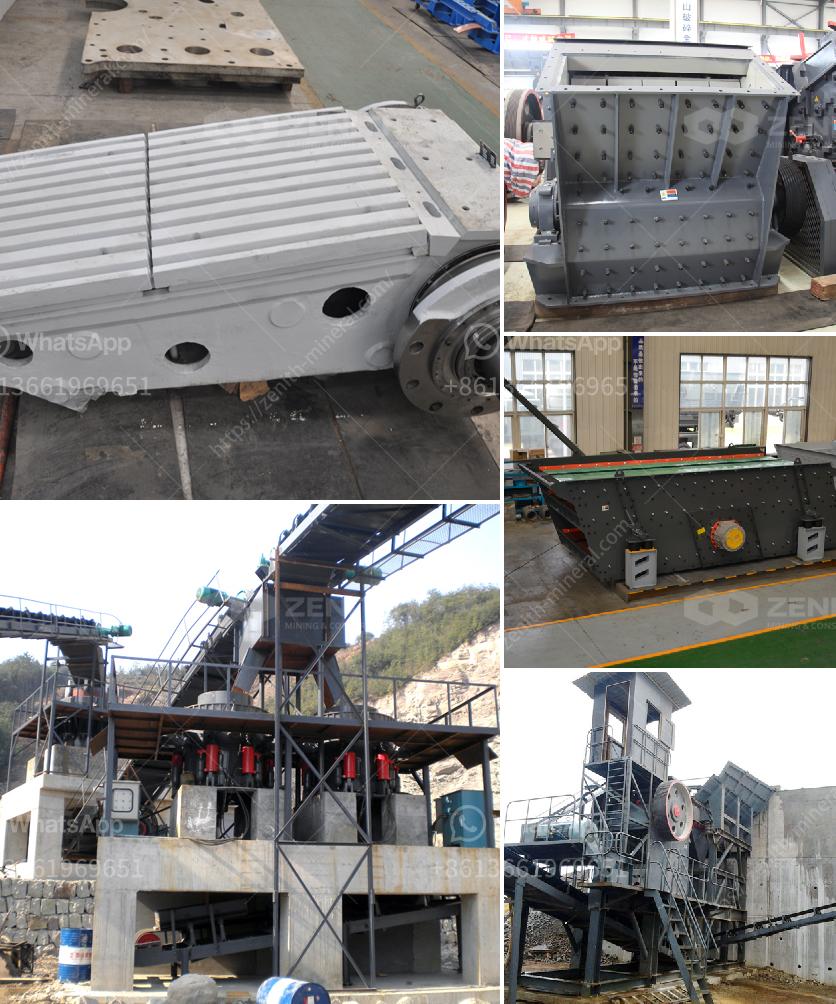
A jaw rock crusher is a type of machinery used in the mining and construction industries to break down large rocks into smaller, more manageable pieces. The working principle of a jaw rock crusher is relatively straightforward, yet it involves several key components and processes that work together to achieve the desired outcome. Here’s a detailed explanation of how a jaw rock crusher works:
Components of a Jaw Rock Crusher
- Fixed Jaw Plate: This is a stationary component that is mounted to the frame of the crusher. It forms one side of the crushing chamber.
- Movable Jaw Plate: This is the component that moves back and forth relative to the fixed jaw plate. It is mounted on a pivot point and is driven by an eccentric shaft.
- Eccentric Shaft: This shaft is driven by a motor and causes the movable jaw plate to oscillate.
- Toggle Plates: These are safety devices that protect the crusher from damage by breaking if the crusher encounters uncrushable material.
- Flywheel: This component stores energy from the motor and releases it to the eccentric shaft to drive the movable jaw plate.
- Pitman Arm: This is the part that transfers the motion from the eccentric shaft to the movable jaw plate.
- Frame: The structure that supports all the components of the crusher.
Working Principle
-
Feeding: Large rocks are fed into the top of the jaw crusher through a hopper. The rocks fall into the crushing chamber, which is formed by the fixed jaw plate and the movable jaw plate.
-
Crushing: The motor drives the eccentric shaft, which in turn causes the movable jaw plate to oscillate. As the movable jaw plate moves towards the fixed jaw plate, the rocks are compressed and crushed. The crushing action is achieved through the movement of the movable jaw plate, which exerts pressure on the rocks, causing them to break into smaller pieces.
-
Discharge: Once the rocks are crushed to the desired size, they fall through the bottom of the crushing chamber and are discharged from the crusher. The size of the discharge opening can be adjusted to control the size of the crushed material.
-
Cycle: The process repeats as the movable jaw plate moves back and forth, continuously crushing and discharging material.
Detailed Process
- Initial Compression: When the movable jaw plate moves towards the fixed jaw plate, the rocks are initially compressed. This initial compression fractures the rocks along their natural lines of weakness.
- Further Crushing: As the movable jaw plate continues to move, the rocks are further crushed into smaller pieces. The crushing action is a combination of compression and shearing forces.
- Release and Discharge: When the movable jaw plate moves away from the fixed jaw plate, the crushed material is released and falls through the discharge opening. The cycle then repeats with new material being fed into the crusher.
Advantages of Jaw Rock Crushers
- Simplicity: Jaw crushers have a simple design and are easy to operate and maintain.
- Versatility: They can handle a wide range of materials, including hard and abrasive rocks.
- Efficiency: Jaw crushers are efficient at breaking down large rocks into smaller, more manageable pieces.
- Durability: The robust construction of jaw crushers makes them durable and capable of withstanding heavy-duty use.
Applications
Jaw rock crushers are widely used in various industries, including:
- Mining: For breaking down ore and other materials to prepare them for further processing.
- Construction: For producing aggregate materials used in construction projects.
- Recycling: For crushing concrete and other materials to be reused in new construction projects.
In summary, a jaw rock crusher works by using a motor to drive an eccentric shaft that causes a movable jaw plate to oscillate. This movement compresses and crushes the rocks against a fixed jaw plate, breaking them into smaller pieces that are then discharged from the crusher. The simplicity, efficiency, and versatility of jaw rock crushers make them an essential tool in the mining, construction, and recycling industries.